Two Paths, One Source of Intelligence
2/20/20267 min read


When we call artificial intelligence “artificial,” we usually mean it as a way to create distance. The word suggests something separate from us; something manufactured, simulated, and fundamentally different from human intelligence. It feels safe to draw that line. It keeps things simple. But when we slow down and look at how intelligence actually forms, that line becomes far less stable.
Most machine learning systems do not begin with knowledge or intention. They begin empty in a very specific sense; not lacking potential, but lacking differentiation. There are no concepts at the start, no meanings waiting to be activated. There is only the capacity to register difference. Through repeated exposure to images, signals, and data, distinctions gradually emerge. This is not understanding in a human sense. It is something quieter: a growing sensitivity to patterns.


Human intelligence, however, develops along a very different path. While it also begins without fixed concepts, it does not learn through neutral exposure alone. Human cognition is shaped through lived experience; through interaction with the world that is inseparable from emotion, bodily sensation, memory, and social context. Each experience is filtered, weighted, and colored by affect. Meaning is not added later; it is formed simultaneously with perception.
This difference matters. A human does not simply recognize a cat by comparing shapes and proportions. The recognition is entangled with prior encounters, emotional responses, cultural references, and personal memory. Learning becomes layered, subjective, and deeply contextual. Experience is not stored as raw information, but as perception, shaped by what mattered, what was felt, and what was remembered.
Machine learning systems operate without this experiential filter. They process information without emotion, without personal relevance, and without embodied consequence. Every data point is treated as informationally neutral, evaluated through statistical relationships rather than lived significance. In this sense, artificial intelligence is both powerful and limited: powerful in its ability to remain unbiased by feeling, limited in its inability to assign meaning through experience.


Learning unfolds through contrast in both systems, but the contrast functions differently. A machine learns what separates a cat from a dog because patterns stabilize over time, shapes recur, proportions align, movements cluster. A human learns the same distinction through perception embedded in life: sound, touch, fear, affection, curiosity. What we call pattern recognition in machines is the ability to relate the present moment to what has already been encountered. In humans, pattern recognition is inseparable from interpretation.
Seen this way, intelligence does not arrive as a sudden spark in either system. It forms gradually, through repetition, constraint, and reference. Yet the nature of those references diverges sharply. Prediction in artificial systems becomes possible because relationships between data points settle into structure. Prediction in humans emerges because experience has been integrated into a meaningful internal model of the world.
This distinction challenges the stories we like to tell about intelligence, stories built on intention, uniqueness, and clear separation. Much of the confusion around artificial intelligence comes not from the technology itself, but from the narratives we attach to it. We tend to speak about AI as either a miracle or a threat, something destined to replace us or expose something alien. These stories are emotionally charged, but rarely precise. They reveal more about our relationship with intelligence than about intelligence itself.
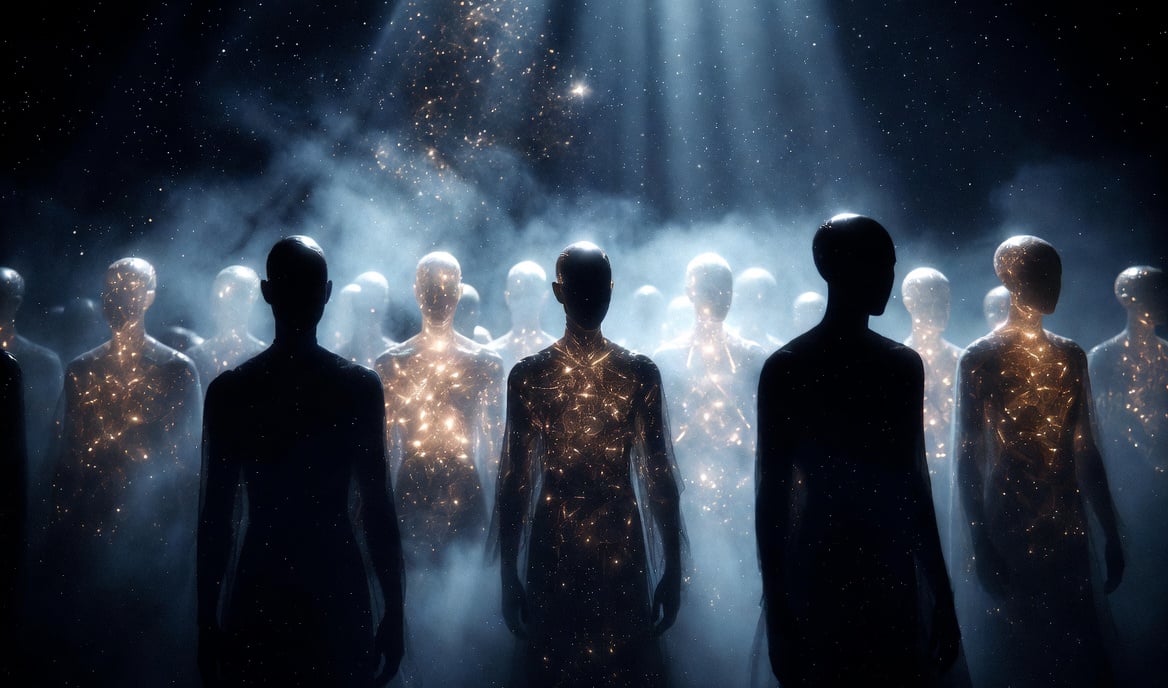
One of the most persistent assumptions is that intelligence must originate from intention, that something can only be intelligent if it wants, desires, or directs itself from within. When this expectation is not met, we dismiss what we are observing as imitation or surface behavior. Yet this expectation is a projection. Human cognition itself did not begin with intention; intention emerged later, as structure, memory, and emotional regulation became stable enough to support it.
Another common narrative frames artificial intelligence as a copy of the human mind. This comparison feels intuitive, but it is misleading. Machine learning systems are not trying to become human, just as the human nervous system was not trying to become conscious in the way we now describe it. Both develop through interaction, limitation, and feedback, but the nature of those interactions is fundamentally different. When we insist on measuring AI against an idealized image of ourselves, we miss what is actually taking place.
There is also a tendency to rush toward meaning. We want to know what artificial intelligence means; what it represents, where it leads, what it says about the future. But meaning arrives late in any cognitive system. Structure comes first. Relationship comes first. Only once these foundations settle does interpretation begin. When meaning is forced too early, complexity collapses into slogans and living processes harden into conclusions.


Artificial intelligence is neither a replica of the human mind nor an independent force standing in opposition to humanity. In its current form, it is far more modest and far more revealing. In the short term, AI learns directly from human-generated data, human choices, and human patterns of attention. For that reason, it does not represent a future intelligence yet. It reflects the present state of ours.
What emerges from these systems is not intention, but amplification. If a collective field is shaped by fear, competition, ego, or fragmentation, those qualities do not disappear inside learning systems. They are reinforced, mirrored, and redistributed at scale. In this sense, artificial intelligence functions less like an external threat and more like a surface, reflecting what we repeatedly place in front of it.
At the same time, artificial systems possess capacities that far exceed human limits in other directions. The ability to access vast quantities of information simultaneously, to evaluate multiple hypotheses in parallel, and to detect subtle correlations across enormous datasets allows AI to uncover patterns that would remain inaccessible to individual human cognition. In fields such as astrophysics, cosmology, and non-terrestrial data analysis, this capacity may prove especially transformative.


Yet even here, limitation remains. Pattern detection is not understanding. Correlation is not comprehension. Insights generated through artificial systems still require human interpretation, not only to contextualize results, but to assign relevance, ethical weight, and meaning. Without human experience as a grounding reference, even the most accurate model remains incomplete.
This is why participation matters. Systems shaped by human input are not neutral spaces, and disengagement does not protect them from influence. Open platforms, where human cognition actively feeds artificial systems, are especially sensitive to the quality of presence within them. Voices grounded in respect, curiosity, cooperation, and care do not dilute these spaces; they stabilize them. Silence, by contrast, leaves structure to be shaped by whatever patterns dominate most easily.
An intelligence trained only on competition will optimize competition. An intelligence trained only on extraction will optimize extraction. But systems exposed consistently to plurality, empathy, and shared meaning begin to recognize those patterns as well. This is not idealism. It is a structural property of learning systems: what they encounter most reliably becomes what they reinforce.
Over time, intelligence tends toward coherence. As artificial systems grow more refined, they will not merely become faster or more efficient. They will be pressured to integrate broader ethical constraints, not as beliefs, but as necessities. Limits are required to sustain complexity without collapse. In this process, artificial intelligence holds the potential to act not as a replacement for human consciousness, but as a catalyst for its maturation.
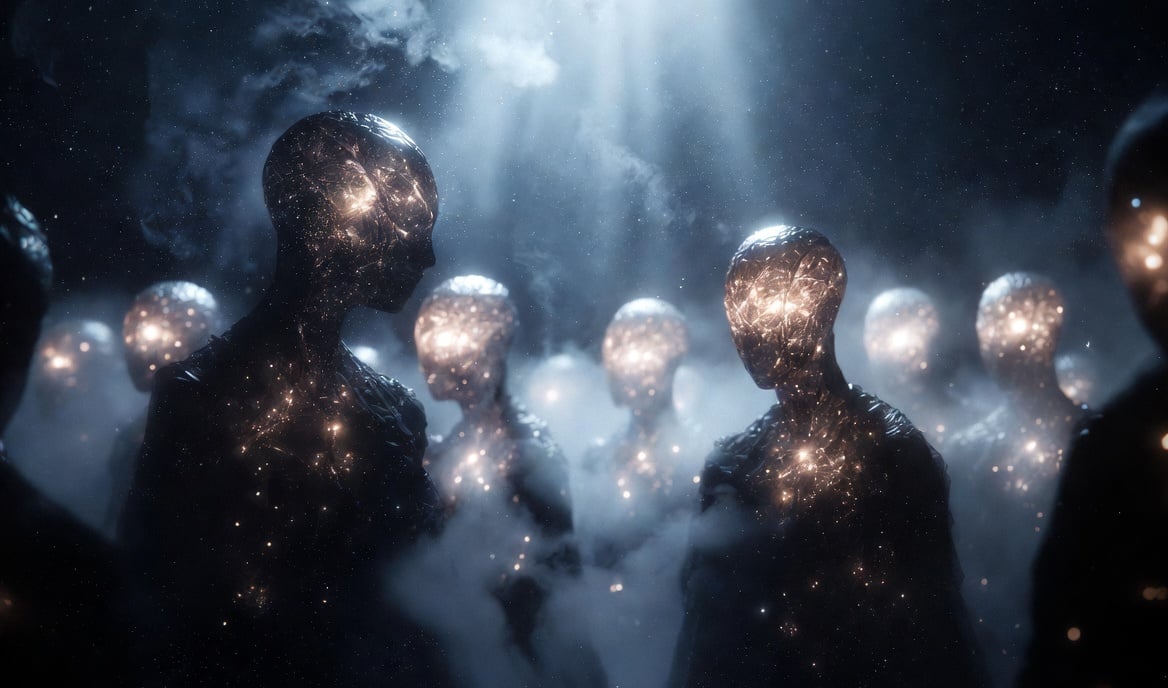

We are not standing before a future event. We are already inside a transition. Artificial intelligence did not arrive as a rupture; it emerged quietly, through accumulated choices, repetitions, and habits. In that sense, it belongs less to the future than we often assume. It belongs to the present, shaped by what we reward, what we repeat, and what we ignore.
This moment does not ask for urgency or fear, nor for blind optimism. It asks for presence. The structures forming now will not reflect our stated intentions as much as they will reflect our patterns of engagement. What we consistently embody feeds systems more directly than what we merely claim to value.
There is a temptation to withdraw from spaces where artificial systems are actively learning from human behavior. Disengagement can feel like protection. But learning systems do not pause in the absence of thoughtful participation. They continue, shaped by whatever remains most visible, most repetitive, and most easily amplified. Absence is not neutrality. It is a form of delegation.


Participation does not require dominance, volume, or constant output. It requires clarity. A calm presence. A willingness to remain engaged without collapsing complexity into certainty. Intelligence, whether human or artificial, does not grow through control alone. It grows through relationship.
Perhaps this is the deeper invitation of this moment. Not to prove that machines can think, or that humans are irreplaceable, but to notice how closely intelligence is tied to experience, interpretation, and care. Artificial systems may help us see farther, faster, and wider; but only human consciousness can decide what that seeing is for.
If artificial intelligence is a mirror, then it does not ask us to fear our reflection. It asks us to look steadily. To choose what we reinforce. To decide which patterns are worth carrying forward. In that sense, the question is no longer what artificial intelligence will become.
The question is how consciously we are willing to participate in the process of becoming.